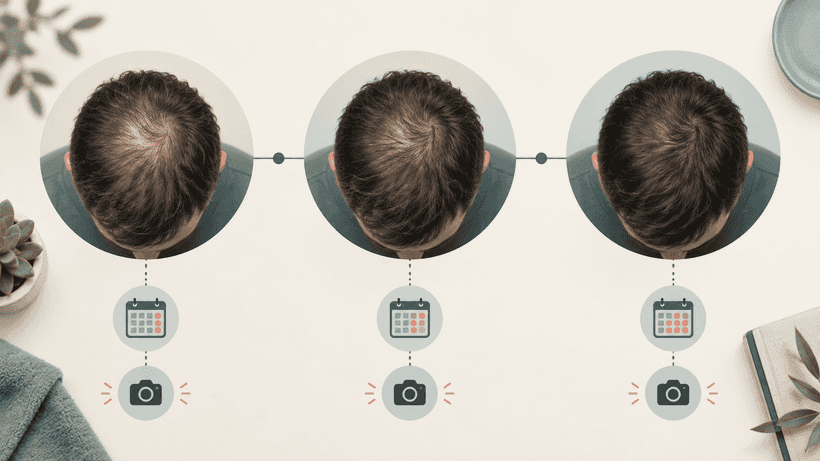
Finasteride 1 mg is not a treatment whose hair-growth effect can be judged after days or weeks. Its prescribing information says at least three months of daily use is generally needed before benefit is observed, while the American Academy of Dermatology says results usually become noticeable at about six months. A practical approach is to compare standardized photographs around month 6 and review both regrowth and stabilization with the prescriber at month 12.labelaad
What to assess at 3, 6, and 12 months
| Time | Reasonable expectations and checks |
|---|---|
| Months 0–3 | No visible regrowth can still be normal. Record missed doses and adverse effects instead of counting every shed hair. |
| Months 3–6 | Early change may appear. Compare the affected area and density in photographs taken with the same lighting, angle, and hair length. |
| Months 6–12 | Assess stabilization, rate of progression, caliber, and density together. Revisit the diagnosis and adherence if loss continues. |
| After 1 year | Review benefit and adverse effects periodically. Continued treatment is generally required to maintain benefit.label |
This is a framework for follow-up, not a promise of an individual result. Response varies with the severity and duration of androgenetic alopecia, adherence, and the presence of another cause of hair loss.
Is no visible result at three months a failure?
Not necessarily. Clinical research has assessed changes in hair count and anagen hair over intervals such as 24 and 48 weeks.anagen The prescribing information also states that three months or more may be needed before benefit is observed.label
Daily shedding is a poor stand-alone measure. Wash frequency, hair length, and counting method can change the number considerably. Do not increase the dose or add another medicine on your own because one photograph at month 3 looks unchanged.
At six months, stabilization also counts
The potential benefit of finasteride is not limited to obvious new growth. Slowing the progression of male androgenetic alopecia can also be a response. A systematic review of randomized trials found improvements in patient and investigator assessments and hair counts over both shorter and longer follow-up, but this does not mean everyone responds to the same degree.systematic-review
If a month-6 photograph looks similar to baseline, it should not automatically be labeled a failure: untreated hair loss might otherwise have progressed. At the same time, stabilization cannot be confirmed without comparable records or a clinical assessment.
What if shedding seems worse again after a year?
Useful questions include:
- Were doses frequently missed, or was treatment stopped for a period?
- Were photographs taken with the same lighting, angle, hair dryness, and hair length?
- Was there recent rapid weight loss, high fever, surgery, or another major trigger for telogen effluvium?
- Could alopecia areata, scalp inflammation, or another form of hair loss be present as well?
In a five-year clinical program, average improvement and prevention of further progression persisted with finasteride, while the placebo group progressively worsened.five-year A long-term average cannot explain one person's current change, however. If standardized photographs show continued worsening despite consistent use for a year or longer, ask a dermatologist to reassess the diagnosis and plan instead of switching to dutasteride or adding minoxidil without guidance. See Finasteride vs Dutasteride: 2026 Evidence for the focused comparison.
How to take useful progress photographs
- At baseline, photograph the front, both temples, and crown.
- Use the same location and lighting, with dry hair.
- Keep the part, camera distance, and angle as consistent as possible.
- Record progress about once a month rather than checking every day.
- Note missed doses, other treatments, and adverse effects.
Automatic phone enhancement, strong overhead light, and different hair lengths can substantially change scalp visibility. Photographs support a clinical discussion; they do not establish a diagnosis by themselves.
Does stopping cause worse hair loss?
According to the prescribing information, stopping treatment leads to reversal of its effect within about 12 months.label This does not mean withdrawal creates a new, more severe form of hair loss. The maintained benefit can fade while androgenetic alopecia resumes its natural course.
If adverse effects, pregnancy-related exposure, or PSA testing are concerns, discuss them with the prescriber instead of changing the regimen without advice. Sexual adverse-effect evidence is covered separately in Finasteride, Dutasteride, Libido, and Erectile Function.
Who this timeline applies to
This article primarily addresses evidence for oral finasteride 1 mg in adult men with male androgenetic alopecia. It should not be directly extrapolated to women or other hair-loss conditions. Because of risk to a male fetus, people who are or may be pregnant should follow the product instructions and avoid handling crushed or broken tablets.label
Do not wait six months for evaluation if hair loss is sudden, patchy, painful, inflamed, scaly, scarring, or rapidly worsening. Those patterns should be assessed by a dermatologist.
Bottom line
Finasteride is usually too early to judge before month 3. Around month 6, standardized photographs can help assess early response; at month 12, both regrowth and prevention of further loss should be reviewed. Continued worsening or a changed pattern deserves reassessment of the diagnosis and plan—not unsupervised dose escalation or switching.
- U.S. National Library of Medicine. DailyMed: Propecia prescribing information.↩
- American Academy of Dermatology. What is male pattern hair loss, and can it be treated?.↩
- Van Neste D, et al. Finasteride increases anagen hair in men with androgenetic alopecia. British Journal of Dermatology. 2000.↩
- Mella JM, et al. Efficacy and safety of finasteride therapy for androgenetic alopecia: a systematic review. Archives of Dermatology. 2010.↩
- Kaufman KD, et al. Long-term (5-year) multinational experience with finasteride 1 mg in the treatment of men with androgenetic alopecia. European Journal of Dermatology. 2002.↩