In classic literature, a bald head is rarely just a physical detail. It can signal ridicule or age, but also warmth, exhaustion, and ordinary city life. Sometimes the most famous bald character of all never even appears. Following six literary examples reveals less about hair loss than about the assumptions writers—and their societies—attached to appearance.
One caveat first: fictional characters cannot be given modern medical diagnoses. Wording also varies between editions and translations: a head may be “bald,” sparsely covered, or simply receding. This article sticks to cases in which the text itself mentions the character’s hair or head.
1. Thersites in The Iliad: when appearance determines who gets heard
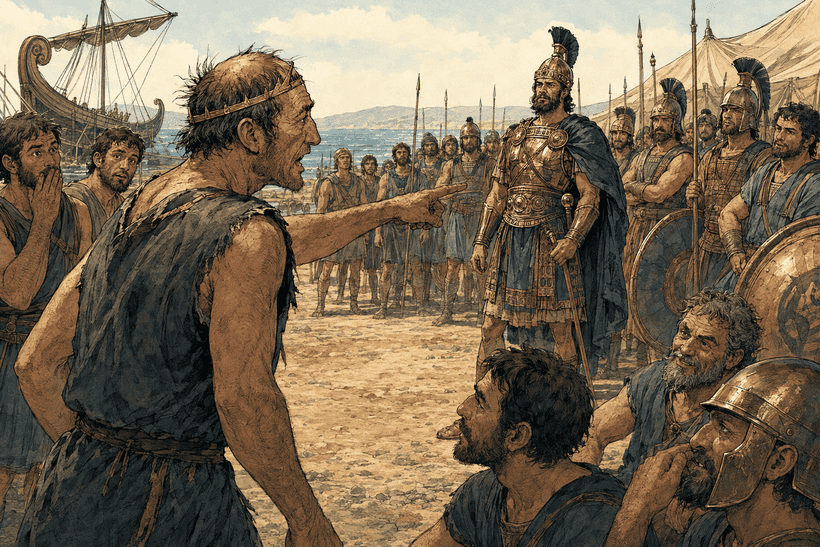
The oldest figure on this list may be Thersites in Book 2 of Homer’s Iliad. He publicly attacks Agamemnon, commander of the Greek army, for his greed. Before giving him the floor, however, the poem catalogues his bent legs, hunched shoulders, pointed head, and sparse crop of hair.iliad
The striking thing is that his criticism is not entirely groundless. Yet his unheroic body and scraggly hair mark him as ridiculous before the argument can be judged. Odysseus strikes him with the sceptre, and the soldiers laugh. Appearance in this heroic world does more than describe character: it helps decide who is entitled to speak.
It is an uncomfortable scene for a modern reader, and that is precisely why it matters. The old habit of treating thin hair as evidence about a person’s worth is already conspicuous in one of the foundational works of Western literature.
2. Bald Father Time in The Comedy of Errors: a 400-year-old hair-loss joke
In Act 2, Scene 2 of Shakespeare’s The Comedy of Errors, Antipholus and Dromio suddenly tumble into an extended routine about baldness. Dromio imagines Time as an old man with a conspicuously bald pate and jokes that there is no time for a man to recover hair lost by nature. A periwig can “recover” somebody else’s lost hair instead.errors
The bald figure here is not a mortal character but Time itself. Hair loss makes aging and time’s passage instantly visible. The joke even comes with its own cosmetic solution: buy a wig. Baldness, age, and appearance management have evidently formed a comic trio for centuries.
The exchange also trades in dated assumptions about hair and intelligence. To a reader now, the routine can be revealing not only because of its punchlines, but because of the beliefs about appearance its original audience was expected to share.
3. Samuel Pickwick in The Pickwick Papers: a bald head becomes a logo
Charles Dickens makes Samuel Pickwick recognizable in the opening chapter of The Pickwick Papers by his “bald head, and circular spectacles.” Beneath the forehead, the narrator extravagantly assures us, Pickwick’s gigantic brain is at work; behind the glasses, his eyes twinkle.pickwick
His design is unmistakably comic. The round, bald head joins the spectacles, gaiters, and ample figure to create a silhouette that can be recognized at once. Yet this comedy works differently from the treatment of Thersites. Dickens’s exaggeration draws the reader toward Pickwick instead of pushing him away. Like the man himself—naive enough to land in trouble, curious and decent enough to keep our affection—the bald head becomes funny, dignified, and endearing at the same time.
Even two “comic bald men” can therefore serve opposite purposes. Laughter helps silence Thersites; with Pickwick, it invites the reader into his company.
4. Marmeladov in Crime and Punishment: the last button of respectability
When Raskolnikov meets Marmeladov in a tavern in Crime and Punishment, the former civil servant is over fifty, bald and grizzled, with a face swollen by continual drinking. His hopelessly worn dress coat has lost every button but one, and that last button is fastened.crime
Here baldness is not a standalone gag. It joins the ragged clothes, stubble, and alcohol-worn face in compressing an exhausted life into a first impression. The single closed button looks like a final attempt to preserve the dignity of an official. Where Pickwick’s round head is a buoyant cartoon emblem, Marmeladov’s is closer to a mark left by time and deprivation.
Dostoevsky nevertheless complicates that first impression. Immediately after describing the degraded exterior, the narrator notices intense feeling and even intelligence in Marmeladov’s eyes. His appearance tells us something, but the person exceeds what it tells us.
5. “Bald Pat” in Ulysses: when an adjective overtakes a name
James Joyce’s Ulysses fills Dublin with citizens who pass briefly through Leopold Bloom’s day. Pat, a waiter at the Ormond Hotel, is repeatedly called “Bald Pat.” He is also hard of hearing. Joyce turns Pat, waiter, and wait into a verbal refrain, making the waiter’s delayed movements part of the episode’s music.ulysses
Pat’s baldness carries no grand symbolic burden. It resembles the instant nickname used to distinguish somebody across a crowded room. That makes it unusually lifelike: people often remember a stranger as “the one with glasses,” “the man in the hat,” or “the bald waiter.” Joyce brings that street-level gaze into the rhythm of the prose.
Today, repeatedly substituting appearance or disability for someone’s name may sound demeaning. The passage captures the vitality of a modern city, but also the way a city reduces strangers to their most visible traits.
6. The Bald Soprano: literature’s most famous bald no-show
No bald soprano actually appears in Eugène Ionesco’s absurdist play The Bald Soprano. The title figure is neither the protagonist nor even a presence on stage. The dialogue begins in the shape of ordinary conversation, then progressively disconnects until words communicate less and sound more like noise.
The baldness in this case is not characterization but a false signpost. A title prompts us to expect a particular person and story; the play refuses to supply either. Earlier works use a bald head to make someone instantly identifiable. Ionesco gives us a label that identifies nobody.
The revealing part is not the hair, but the gaze
There is no single meaning to baldness in world literature. It helps exclude Thersites and embody aging in Father Time. It makes Pickwick lovable, records Marmeladov’s exhaustion, and supplies urban shorthand for Pat. With Ionesco, it leaves the body altogether and becomes a joke about language.
One habit persists across these very different works. A few hairs—or their absence—tempt observers to invent a story about age, intelligence, health, status, and character. Attentive reading asks us not to accept that story too quickly: Is this who the character is, or merely how a narrator and a period have taught us to see him?
So when a bald figure next appears in a classic, look at the head—but do not stop there. What fills the empty space may reveal more about the observer than about the hair.
- Homer, Iliad, Book 2, lines 211–277, English text at the Perseus Digital Library. Translations variously describe the hair as “scant stubble” or “thin, scraggly tufts.”↩
- William Shakespeare, The Comedy of Errors, Act 2, Scene 2, text at the Folger Shakespeare Library.↩
- Charles Dickens, The Pickwick Papers, Chapter 1, text at Project Gutenberg.↩
- Fyodor Dostoevsky, Crime and Punishment, Part 1, Chapter 2, translated by Constance Garnett, text at Project Gutenberg.↩
- James Joyce, Ulysses, Episode 11, “Sirens,” text at Project Gutenberg.↩