A gradually widening part and finer hair at the crown can suggest female pattern hair loss, but a photograph cannot confirm the diagnosis. Telogen effluvium and other scalp conditions can look similar. The history of the change and a scalp examination help establish the cause.cmajdiagnosis
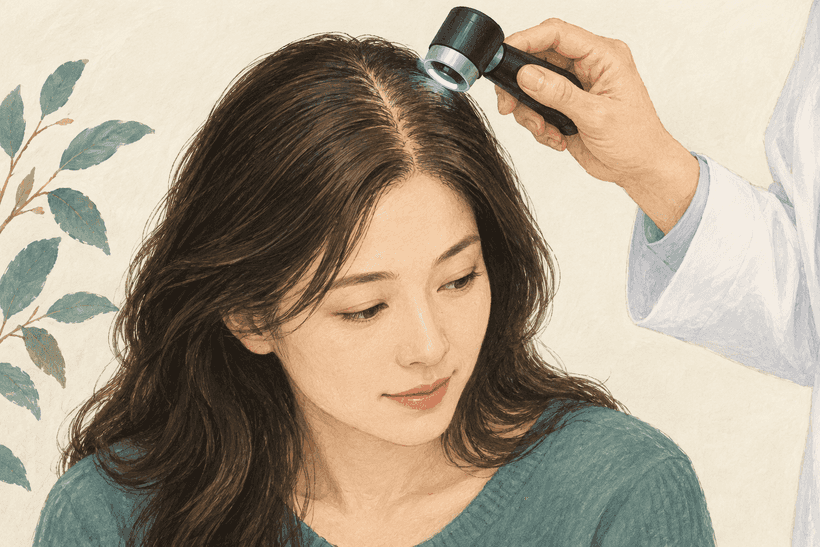
AI-generated editorial illustration; not a photograph of a patient, product, or treatment result.
What changes can suggest female pattern hair loss?
Affected follicles gradually produce finer hair, often reducing density along the part and over the top of the scalp. Genetic and hormonal factors contribute, but the diagnosis does not automatically mean that hormone levels are abnormal.badcmaj
Compare photographs taken with the same lighting and part placement. A visible scalp in one photograph is less informative than a consistent change over time. See Tracking Hair Changes at Home for a practical recording method.
How is it different from sudden shedding?
Telogen effluvium can cause increased shedding across the scalp after childbirth, illness, or rapid weight loss. It can coexist with female pattern hair loss, so heavy shedding does not exclude pattern loss, and a widening part does not exclude telogen effluvium.telogen
| Change noticed | Question for the consultation |
|---|---|
| A gradually widening part | Is there a patterned change in hair caliber and density? |
| A recent increase in shedding throughout the scalp | Was there childbirth, illness, weight loss, or a medication change? |
| A distinct round patch | Should alopecia areata or another cause be evaluated? |
| Pain, burning, or a scar-like change | Is an inflammatory or scarring condition possible? |
These are consultation prompts, not diagnostic criteria. Related guides cover Hair Loss After Weight Loss and Iron Deficiency and Ferritin Testing.diagnosis
Does everyone need blood tests?
Assessment starts with the timing and pattern of loss, family history, medicines, recent health changes, and scalp examination. Trichoscopy, blood tests, or a scalp biopsy may be selected when needed; a standard test panel is not necessary for everyone.diagnosis
A 2026 CMAJ clinical summary recommends considering ferritin or thyroid testing when an alternative cause is suspected. This is a summary of existing evidence, not a new treatment trial. A single blood result cannot confirm or rule out female pattern hair loss.cmaj
Bring a timeline, medication and supplement list, and notes about menstrual changes, childbirth, weight changes, and scalp symptoms. Mention irregular periods or unusual body-hair changes as well.baddiagnosis
Which treatments might be considered?
Treatment follows diagnosis. Topical minoxidil can help some people slow progression and improve growth, but it does not guarantee a return to original density. Approved indications and directions vary by country, product, and formulation.bad
| Option | Points to discuss |
|---|---|
| Topical minoxidil | Product directions, irritation, pregnancy and breastfeeding plans |
| Low-dose oral minoxidil | Off-label status for hair loss and systemic adverse effects |
| Spironolactone | Suitability, blood pressure, kidney function, potassium, and pregnancy precautions |
| Wigs, hairpieces, or camouflage | Appearance support rather than medical treatment |
Oral minoxidil and spironolactone may be prescribed off-label for hair loss. Spironolactone can require potassium monitoring depending on kidney function, other medicines, and individual risk. Do not copy an online medication combination.badspiro See the Low-Dose Oral Minoxidil Guide for more context.
When should treatment be assessed?
The American Academy of Dermatology explains that topical minoxidil may require six to twelve months of continuous use to assess benefit. Early shedding or irritation can occur, and continued treatment is needed to maintain benefit when it works.aad
That is not a reason to delay review of rapid worsening or adverse effects. Contact the clinician earlier if these occur. The Minoxidil Shedding Guide explains questions to bring to that appointment.
For practical comparison, take monthly photographs with dry hair, the same part, lighting, and angle. Discuss density, shedding, irritation, and difficulty maintaining the routine rather than relying only on whether a photograph looks better.
Pregnancy plans and when to seek care
Tell the clinician before starting medication if you are pregnant, planning pregnancy, or breastfeeding. Minoxidil should be avoided during pregnancy and breastfeeding, and spironolactone should not be used during pregnancy. Changing the formulation does not automatically remove these precautions.aadspiro
Seek dermatologic evaluation for sudden, patchy, painful, scarring, or rapidly worsening loss. Persistent gradual part widening also deserves assessment before choosing treatment.diagnosiscmaj
Sources
- McMullen E, et al. Female pattern hair loss. CMAJ. 2026;198:E295. Clinical summary. Accessed 2026-10-04.↩
- American Academy of Dermatology. Hair loss: Diagnosis and treatment. Accessed 2026-10-04.↩
- British Association of Dermatologists. Hair loss — female pattern (androgenetic alopecia). Patient leaflet, October 2024. Accessed 2026-10-04.↩
- British Association of Dermatologists. Telogen effluvium. Accessed 2026-10-04.↩
- British Association of Dermatologists. Spironolactone. Patient leaflet, August 2025. Accessed 2026-10-04.↩
- American Academy of Dermatology. Thinning hair and hair loss: Could it be female pattern hair loss?. Accessed 2026-10-04.↩