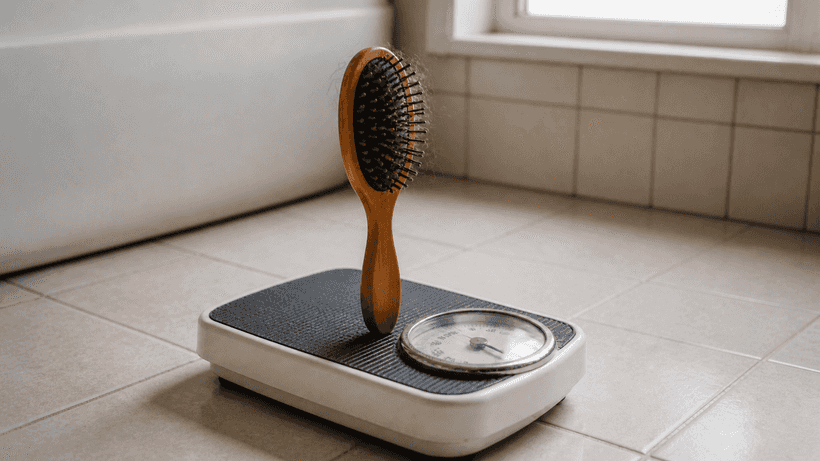
Rapid weight loss or severe dietary restriction can trigger diffuse shedding called telogen effluvium. It often becomes noticeable weeks to months after a diet begins rather than immediately. Many people improve once the trigger has passed and weight and food intake have stabilized. The timing and recovery period vary, however, and not every case of hair loss after dieting is telogen effluvium.aad-sheddingkang
Why can dieting affect hair?
Most scalp hairs are normally in the growth phase. A major physical stress—such as rapid weight change, marked calorie restriction, illness, or surgery—can shift more growing hairs than usual into the resting phase. Those hairs do not fall immediately, which creates a delay between the trigger and visible shedding. This pattern of diffuse shedding is called telogen effluvium.kang
The number on the scale may not be the only factor. Inadequate overall intake, insufficient protein, a true nutrient deficiency, and illness, fever, surgery, or psychological stress occurring during a diet may contribute. If weight loss was unintentional, do not assume the shedding is simply a consequence of dieting; the reason for the weight loss itself needs assessment.
When does shedding usually begin?
Classic telogen effluvium is often described as beginning about two to three months after the triggering event. The American Academy of Dermatology similarly notes that excessive shedding may become visible a few months after substantial weight loss.aad-sheddingkang
The timeline is not identical for everyone. A 2024 single-center Korean retrospective study of 140 patients with weight-loss-associated telogen effluvium recorded a mean onset 1.12 months after weight loss, with a range from immediately to six months.kang Because this was a review of records from one center, the figure is an observation—not a rule that predicts shedding exactly one month after a diet.
People often notice suddenly more hair in the shower or brush and less volume across the scalp rather than one isolated bald spot. Shedding from the root also differs from hair breaking midway because of heat, bleach, or friction. If most strands are short and broken, hair-care damage may be contributing.
How much weight loss causes hair loss?
There is no universal amount or rate of weight loss that triggers telogen effluvium. Two people can lose a similar amount of weight and have different hair outcomes.
In the Korean study, patients had lost an average of 15.21% of their previous body weight at an average rate of 3.54 kg per month. But the study included only people already diagnosed with weight-loss-associated telogen effluvium and had no comparison group of dieters without shedding. The investigators also could not determine whether more weight loss produced more severe shedding.kang These averages are therefore neither a safe threshold nor a danger cutoff.
Will it grow back, and how long does recovery take?
Acute telogen effluvium does not usually destroy follicles through scarring, so regrowth is likely after the trigger resolves. The American Academy of Dermatology says excessive shedding often stops as the body readjusts, with normal fullness tending to return within six to nine months.aad-shedding
In the Korean retrospective study, all patients improved during follow-up without a specific treatment, and the mean recovery period was 4.83 months. The range was wide—0.5 to 16 months—and the study did not track whether participants regained weight.kang It cannot promise complete recovery on a fixed timetable.
Hair grows slowly, so visible density may lag behind the reduction in shedding. Recovery may also take longer if restrictive eating or weight loss continues, or if male- or female-pattern hair loss is present at the same time.
What can support recovery?
The priority is not a special shampoo or supplement but identifying and correcting an ongoing trigger.
- Avoid crash diets, prolonged fasting, or diets built around one food. Review current intake and the pace of weight loss with a clinician or qualified dietitian.
- Include varied sources of protein along with vegetables, grains, and other balanced foods. Individual needs vary with body size, health conditions, activity, and the weight-management plan.
- Discuss persistent vomiting, diarrhea, loss of appetite, or swallowing problems that interfere with eating.
- Limit bleaching, high-heat tools, and tightly pulled hairstyles to reduce additional damage to fragile hair.
- Take monthly photos of the part and hairline in consistent lighting and from the same angle.
Not everyone needs a broad panel of iron, zinc, vitamin D, and biotin tests—or high-dose supplements. A 2024 study comparing 90 women with chronic telogen effluvium and 90 controls found no group differences in ferritin, vitamin B12, vitamin D, thyroid tests, or biotin. Its authors recommended starting with a detailed history and examination, then individualizing tests for suspected conditions.nutrient-study A confirmed deficiency may need correction, but taking multiple supplements without testing does not guarantee regrowth and can cause harm in excess.
Signs that it may not be telogen effluvium
Do not attribute every change to weight loss just because the timing overlaps. See a dermatologist if you have:
- sudden round or patchy areas of hair loss
- progressive thinning mainly at the hairline or crown
- scalp pain, marked itching, redness, scale, or pustules
- smooth, shiny, or scar-like areas without visible follicle openings
- rapidly worsening shedding or clearly persistent shedding beyond six months
- unintentional weight loss, marked fatigue, cold intolerance, menstrual changes, or other systemic symptoms
Telogen effluvium can also make pre-existing pattern hair loss become noticeable sooner. A dermatologist can use the history and scalp examination to decide whether selective blood tests or other evaluation is appropriate.
If you are using a GLP-1 weight-loss medication
If shedding began while losing weight after starting Wegovy, Ozempic, Mounjaro, or a related medication, the medication, rate of weight loss, and change in food intake all need consideration. Do not stop a prescription on your own; discuss it with the prescriber. See Do Wegovy, Ozempic, and Mounjaro Cause Hair Loss? for the drug-specific evidence.
Bottom line
Diffuse shedding after dieting may be telogen effluvium triggered by rapid weight loss or restrictive intake. It can appear after a delay of weeks to months and often improves after the trigger stabilizes, but the timeline varies. Do not treat a specific percentage of weight loss as a safety threshold or take supplements indiscriminately. Review whether the diet is nutritionally adequate, and seek dermatologic assessment if loss is patchy, painful, scarring, rapidly worsening, or otherwise unusual.
Sources
- American Academy of Dermatology. Do you have hair loss or hair shedding?. Accessed 2026-08-22.↩
- Kang DH, Kwon SH, Sim WY, Lew BL. Telogen Effluvium Associated With Weight Loss: A Single Center Retrospective Study. Annals of Dermatology. 2024;36(6):384-388. doi:10.5021/ad.24.043.↩
- Durusu Turkoglu IN, et al. A comprehensive investigation of biochemical status in patients with telogen effluvium. Journal of Cosmetic Dermatology. 2024;23(12):4277-4284. doi:10.1111/jocd.16512.↩