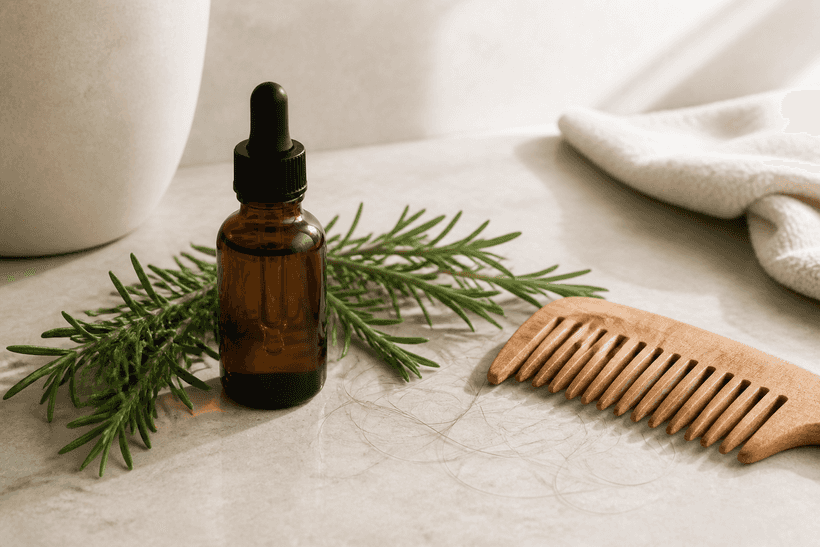
Rosemary oil may have some potential for pattern hair loss, but the evidence is too limited to call it a proven substitute for standard treatment. The claim rests largely on one small six-month comparative trial. That study found increased hair counts with both rosemary oil and topical minoxidil 2%, but it did not include a placebo group and does not show that rosemary oil works for every type of hair loss.panahinatural-review
What did the rosemary oil trial find?
The study most often cited online randomized 100 people with androgenetic alopecia—male- or female-pattern hair loss—to use either rosemary oil or minoxidil 2% for six months. Researchers assessed hair counts with standardized microphotographs.panahi
At three months, neither group had a statistically significant increase in hair count. At six months, both groups had increased hair counts compared with baseline, and the difference between the two groups was not statistically significant. Scalp itching increased in both groups but was reported more often in the minoxidil group.panahi
Those results are interesting, but they are often overstated. “No statistically significant difference” does not prove that two treatments are equivalent. The trial was relatively small, had no vehicle or placebo group, followed participants for only six months, and compared rosemary oil with 2% minoxidil, not every minoxidil formulation or dosing schedule used in current practice. Recent reviews therefore describe rosemary oil as promising while emphasizing the need for larger, better-controlled trials and long-term safety data.nonprescription-reviewherbal-review
Which kinds of hair loss were not tested?
The trial studied pattern hair loss. It does not establish that rosemary oil treats:
- sudden diffuse shedding after illness, childbirth, rapid weight loss, or severe stress
- alopecia areata, which often causes smooth round patches
- scarring alopecia
- hair breakage caused by bleach, heat, or friction
- hair loss related to thyroid disease, iron deficiency, medication, or another medical condition
This distinction matters because “hair loss” is a symptom, not one diagnosis. A product studied for androgenetic alopecia cannot automatically be assumed to work for unrelated causes.
Rosemary Plant by Jane6592, via Wikimedia Commons, CC BY-SA 4.0; resized only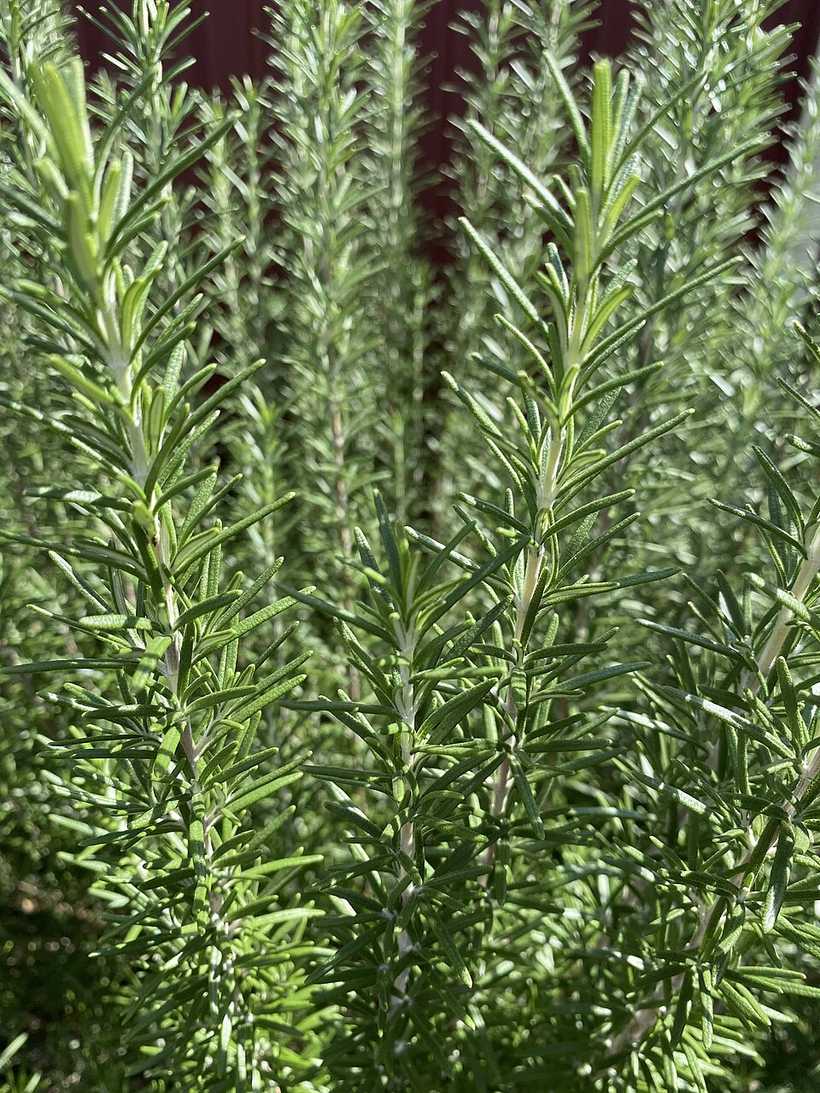
Photo: Jane6592, “Rosemary Plant,” Wikimedia Commons, licensed under CC BY-SA 4.0. The image was resized; no other changes were made.

Does rosemary oil block DHT?
Claims that rosemary oil “blocks DHT” or works by the same mechanism as finasteride are not established by this human trial. Laboratory or animal findings can suggest a possible mechanism, but they cannot determine whether a scalp product prevents clinically meaningful hair loss in people. The six-month trial measured hair counts; it did not demonstrate DHT suppression in participants.panahinatural-review
That is why a plausible biological explanation should not be treated as proof of clinical benefit.
Is it safe to apply rosemary essential oil directly to the scalp?
“Natural” does not mean irritation-free. Essential oils can cause irritant or allergic contact dermatitis, and undiluted essential oils should not be applied directly to skin because this can increase the risk of sensitization.dermnet Rosemary itself has also been reported as a cause of allergic contact dermatitis.rosemary-dermatitis
If you choose to try a cosmetic rosemary scalp product:
- use a product formulated for skin or scalp rather than swallowing essential oil or applying a concentrated product neat
- follow the product directions instead of assuming a homemade concentration matches the clinical trial
- stop using it if burning, persistent itching, redness, swelling, or scaling develops
- avoid applying it to broken or inflamed skin
- ask a clinician first if you are pregnant, breastfeeding, treating a child, or have eczema or a known fragrance allergy
There is no well-established do-it-yourself dilution or universal application schedule proven to regrow hair. A patch test may reduce surprises, but it cannot guarantee that dermatitis will not develop with repeated use.
Should rosemary oil replace minoxidil or prescription treatment?
The current evidence does not justify stopping an effective treatment and replacing it with rosemary oil without medical advice. The single comparison with minoxidil 2% is not proof that rosemary oil matches all approved or guideline-supported treatments. It also tells us little about combining rosemary oil with minoxidil, finasteride, or other therapies.panahinonprescription-review
If you are already using medication, discuss additions with the prescriber or dermatologist. Adding several products at once can make irritation more likely and makes it difficult to know which product helped or caused a reaction.
When to see a dermatologist
Seek an assessment rather than experimenting with oils alone if hair loss is sudden, patchy, painful, rapidly worsening, or associated with redness, heavy scale, pustules, or smooth scar-like skin. Evaluation is also appropriate when shedding persists, the diagnosis is uncertain, or there are symptoms such as unexplained weight change, marked fatigue, or menstrual changes.
A dermatologist can distinguish pattern hair loss from shedding, breakage, inflammatory scalp disease, and scarring conditions. Earlier diagnosis is especially important when scarring hair loss is possible because permanent follicle damage can occur.
Bottom line
Rosemary oil has an encouraging but small evidence base for pattern hair loss. One 100-person trial found increased hair counts after six months in both the rosemary oil and minoxidil 2% groups, but its design cannot prove that rosemary oil is equivalent to minoxidil or effective for other causes of hair loss. If you try it, use a scalp-formulated product, watch for dermatitis, and do not delay diagnosis or replace established treatment on the strength of social-media claims.
Sources
- Panahi Y, Taghizadeh M, Marzony ET, Sahebkar A. Rosemary oil vs minoxidil 2% for the treatment of androgenetic alopecia: a randomized comparative trial. Skinmed. 2015;13(1):15-21. PMID: 25842469.↩
- Bin Rubaian NF, Alzamami HFA, Amir BA. An Overview of Commonly Used Natural Alternatives for the Treatment of Androgenetic Alopecia, with Special Emphasis on Rosemary Oil. Clin Cosmet Investig Dermatol. 2024;17:2495-2503. doi:10.2147/CCID.S470989.↩
- Gupta AK, Talukder M, Venkataraman M. Do Non-Prescription Products Help in Managing Androgenic Alopecia?. Skin Appendage Disord. 2025. PMID: 40475103.↩
- Allam AT, et al. Pathophysiology, conventional treatments, and evidence-based herbal remedies of hair loss with a systematic review of controlled clinical trials. Naunyn Schmiedebergs Arch Pharmacol. 2025;398(12):16311-16354. doi:10.1007/s00210-025-04286-6.↩
- DermNet. Allergic contact dermatitis to essential oils. Reviewed January 2020.↩
- González-Muñoz P, Conde-Salazar L, Vañó-Galván S. Allergic contact dermatitis caused by Rosmarinus officinalis. Contact Dermatitis. 2014;70(1):9-10. doi:10.1111/cod.12117.↩