Adding scalp microneedling to minoxidil does not necessarily improve results for female pattern hair loss. In a 2026 randomized trial of 245 women, outcomes after 24 weeks did not differ significantly between 2% topical minoxidil alone and minoxidil combined with microneedling. Because earlier pooled research suggested a benefit, microneedling cannot yet be considered a necessary add-on for everyone.trialmeta
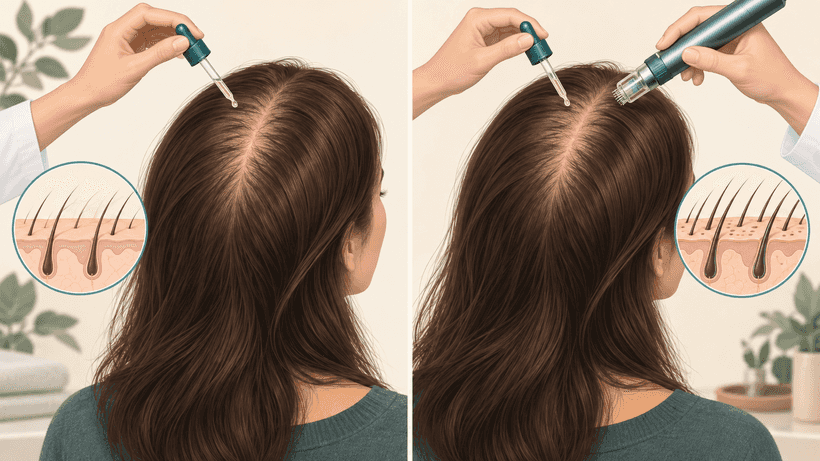
What did the new study compare?
The original paper, published online in the Journal of the American Academy of Dermatology in 2026, was a 24-week randomized trial involving 245 women with mild-to-moderate androgenetic alopecia. Participants were assigned to one of three groups.trial
| Group | Treatment |
|---|---|
| Minoxidil alone | Topical 2% minoxidil |
| Monthly combination | 2% minoxidil plus microneedling every 4 weeks |
| Every-2-week combination | 2% minoxidil plus microneedling every 2 weeks |
The researchers used a 36-needle cartridge at a depth of 0.5 to 0.55 mm. Their main outcome was the change in nonvellus hair count in a defined scalp area; 234 participants completed the study.trial
What did the trial find?
Nonvellus hair counts increased from baseline in all three groups after 24 weeks. However, there was no statistically significant difference between minoxidil alone and either microneedling group. Hair-shaft diameter, vellus hair count, hair density, and other secondary outcomes were also comparable.trial
This does not prove that microneedling never helps hair loss. It means that, in women using 2% minoxidil, this particular device, depth, and schedule did not produce a measurable additional benefit within 24 weeks.
Why does this differ from earlier research?
A 2025 systematic review and meta-analysis evaluated 12 randomized trials involving 631 people with androgenetic alopecia. Its pooled results favored combined microneedling and minoxidil for hair count and diameter. However, hair-count results varied substantially among studies, and the devices, needle depths, schedules, and participants were not uniform.meta
The newer trial adds a relatively large, direct comparison focused on women. It was also conducted at one center, was open-label, and lacked patient-reported outcomes. One study therefore cannot settle the question for every microneedling protocol or extend its result automatically to men.trial
Is an at-home dermaroller equivalent?
No. The new study used a defined device and protocol in a controlled trial; it did not test unsupervised home dermarolling. There is also no basis here for assuming that deeper or more frequent needling works better.trialmeta
Microneedling can cause temporary redness, swelling, pain, and dryness. Less common persistent problems reported in the broader safety literature include post-inflammatory hyperpigmentation, track-like scarring, and granulomatous reactions. Extra caution is warranted with active infection, metal allergy, or products not approved for intradermal delivery.safety
Do not needle an inflamed, infected, or wounded scalp, and do not increase minoxidil strength or frequency on your own. For the basics of topical minoxidil, see minoxidil strengths, formulations, and directions.
How should women weigh their options?
First confirm that the thinning is female pattern hair loss. Telogen effluvium, alopecia areata, and inflammatory or scarring alopecias require different evaluation and management. The American Academy of Dermatology describes topical minoxidil as the most-recommended treatment for female pattern hair loss and notes that six to 12 months of consistent use may be needed to judge results.aad
Women who are pregnant, planning pregnancy, or breastfeeding are advised to avoid minoxidil. If scalp irritation is significant or you are considering an add-on procedure, discuss the diagnosis, likely benefit, cost, and adverse effects with a dermatologist before starting microneedling.aad
Seek dermatologic evaluation for sudden, rapidly worsening, patchy, painful, inflamed, or possibly scarring hair loss.
Key takeaways
In a 2026 randomized trial, adding microneedling to 2% topical minoxidil did not provide an additional benefit over minoxidil alone for women after 24 weeks. Earlier pooled trials suggested possible benefit, but their methods and results varied. Current evidence does not show that everyone needs microneedling or that deeper, more frequent, or at-home treatment is better.
Sources
- Liu Y, et al. Microneedle frequency adjunct to 2% minoxidil in female androgenetic alopecia: A randomized controlled trial. J Am Acad Dermatol. Published online May 25, 2026.↩
- Ahmed KMA, et al. Evaluating the efficacy and safety of combined microneedling therapy versus topical Minoxidil in androgenetic alopecia: a systematic review and meta-analysis. Arch Dermatol Res. 2025;317:528.↩
- Chu S, et al. Safety Profile for Microneedling: A Systematic Review. Dermatol Surg. 2021;47:1249–1254.↩
- American Academy of Dermatology. Thinning hair and hair loss: Could it be female pattern hair loss?. Accessed 2026-09-30.↩