Women can use certain 5% minoxidil products, and men can use certain lower-strength products. Before comparing prices, check the strength, formulation, approved users and directions. Check the formulation, approved users, application amount and frequency together. For example, South Korea’s Dongsung Minoxidil 3% lists directions for both sexes, while the US has a women’s 5% Rogaine foam.kr3women
This comparison covers minoxidil applied to the scalp. It does not apply directly to oral tablets or combination treatments containing other active drugs.
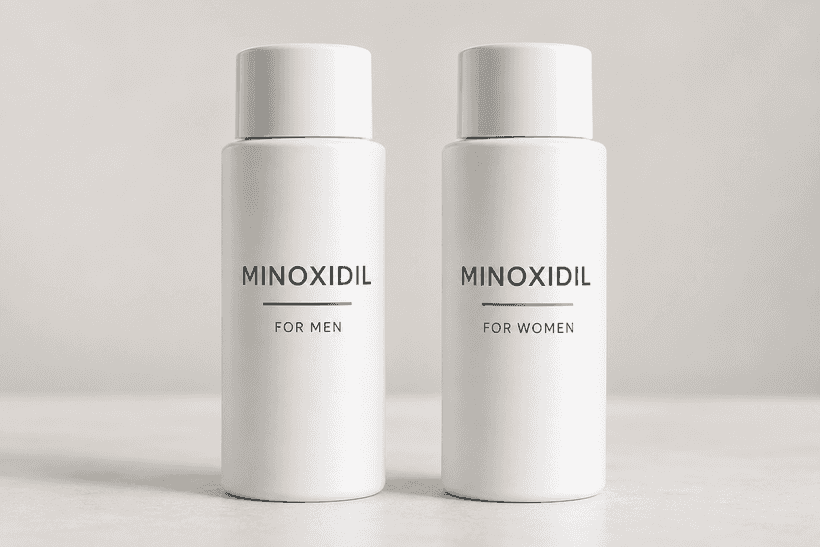
What differs between men’s and women’s minoxidil?
In a minoxidil-only medicine, the active drug is minoxidil in either version. Compare each product’s strength, inactive ingredients and directions using the following criteria.kr3womenmen
| Item | What to compare |
|---|---|
| Strength | Concentration, such as 2%, 3% or 5% |
| Formulation | Liquid solution or foam |
| Inactive ingredients | Solvents, moisturizing ingredients and the complete ingredient list |
| Approved users and directions | Intended users, amount per application and daily frequency |
| Packaging and cost | Total contents, unit price and duration under your directions |
The table compares the labels of three products sold in Korea and the US.
| Product example | Strength and form | Labeled users and frequency |
|---|---|---|
| Dongsung Minoxidil 3%, South Korea | 3% solution | Both sexes, twice daily; application amounts differ |
| Women’s Rogaine Unscented, US | 5% foam | Women, once daily |
| Men’s Rogaine Unscented, US | 5% foam | Men, twice daily; label says women should not use it |
The comparison uses manufacturer and DailyMed information. Follow the instructions supplied with the product you buy.kr3womenmen
Why is women’s minoxidil often a lower strength?
Lower-strength minoxidil is an option that balances benefit and adverse effects in women. Women also use 5% minoxidil, with directions depending on the formulation and approved regimen.faq
A 48-week randomized trial assigned 381 women to 5% solution, 2% solution or placebo, applied twice daily. The 5% solution outperformed placebo and did better than 2% on one patient-rated benefit measure, but itching, local irritation and unwanted hair growth were more frequent with 5%. These trade-offs matter when considering a stronger product.women-trial
Differences in benefit varied by study and outcome measure. A 2016 Cochrane systematic review did not establish a consistent advantage for the higher concentration across the studies comparing 2% and 5%. Formulations and application schedules also need attention.cochrane
Women’s 5% foam was studied and approved specifically for once-daily use in women. When choosing a women’s product, check the formulation and application frequency alongside the concentration.faq
Can a man use women’s minoxidil?
A lower-strength product that is labeled for men can be an option. Dongsung Minoxidil 3% in South Korea, for instance, explicitly provides male dosing instructions. The product leaflet specifies its intended users and application amounts for each sex.kr3
However, a man switching from 5% to 2% should not assume equal results. A 48-week randomized trial involving 393 men found 5% solution superior to 2% solution on hair counts and several assessments. If irritation is prompting a lower-strength switch, discuss the expected benefit alongside your symptoms.men-trial
If you are searching Korean product names such as “미녹실,” check the exact name, active ingredient and strength on the box. The studied schedule can differ by sex even at the same concentration, so check the directions that apply to you.menfaq
Can a woman use men’s minoxidil?
Women also use 5% minoxidil. Before switching to a men’s product, confirm its suitability for women and the appropriate directions.faq
US men’s and women’s Rogaine Unscented 5% foams list the same active concentration and inactive ingredient names. The documented differences in this example concern the intended users and frequency: once daily for women and twice daily for men. The men’s label also says women should not use it.womenmen
If cost is prompting a switch, show a pharmacist both the current and proposed products. First check for an alternative approved for women. If the proposed use falls outside its approved labeling, discuss its suitability and directions with a dermatologist. Check the application amount and frequency for the specific liquid or foam product.faq
Do inactive ingredients cause problems when switching between men’s and women’s products?
The relevant concerns are individual allergies and scalp irritation. The US men’s and women’s Rogaine Unscented 5% foams compared above list the same inactive ingredients. We found no basis for treating those shared ingredients as a special hazard simply because someone switches between the gender-labeled versions.womenmen
Checking the ingredient list helps you identify ingredients that have previously irritated your skin or caused an allergy. Propylene glycol in some solutions can cause contact allergy, and ethanol can sting damaged skin. These precautions apply to both men and women.allergyexcipients
When switching, compare the old and new ingredient lists, especially if you have sensitive skin or a history of reactions to cosmetics or topical medicines. Formulas vary by brand and formulation: Korea’s Dongsung Minoxidil 3%, for example, lists butylene glycol and dexpanthenol.kr3
Stop use and seek advice if itching or redness develops. Minoxidil itself can also cause allergy, so a dermatologist can help identify the cause of recurring symptoms.aadallergy Check concentration, approved users and application frequency separately from the inactive ingredients.
If women’s minoxidil costs more, is switching worthwhile?
Higher prices for women’s products have been documented. A US price study published in 2025 found women-marketed foams cost approximately 20% more per standardized volume than men-marketed foams. Prices were collected in July–August 2024. The study describes US prices at that time. Compare current local prices and pack sizes to estimate your own costs. Clinical evidence and product information establish differences in efficacy and ingredients.price
Compare products in this order:
- Establish suitability first. The product’s approved users and directions must fit your treatment.
- Compare the same strength and formulation. A bottle of 3% liquid and a can of 5% foam are different comparisons.
- Compare total contents and unit prices. Use consistent mL units for liquids and g units for foams.
- Calculate cost using your instructed daily amount. A “months’ supply” claim can depend on application frequency.
A practical calculation is price ÷ total contents × your daily amount × 30 days. Use the daily amount specified in your leaflet or by your clinician in this calculation. Maintain the instructed frequency and avoid diluting a stronger product with water yourself.
When an assessment should come before switching
Avoid minoxidil during pregnancy, while planning pregnancy and while breastfeeding, and discuss a treatment plan. This precaution also applies to women’s and lower-strength products.aad
Stop use and seek medical advice for chest pain, rapid heartbeat, dizziness, swelling of the hands or feet, or sudden unexplained weight gain.women Sudden, patchy, scarring, painful or rapidly worsening hair loss also needs a dermatologist’s assessment before experimenting with products.
For related questions, see female pattern hair loss and a widening part and minoxidil shedding.
- Dongsung Pharmaceutical — Minoxidil 3% ingredients, indications and directions.↩
- DailyMed — Women’s Rogaine Unscented 5% foam label.↩
- DailyMed — Men’s Rogaine Unscented 5% foam label.↩
- ROGAINE — Women’s foam clinical testing and approval FAQ.↩
- Lucky et al., 2004 — Randomized trial of 5% and 2% solutions in women.↩
- Cochrane, 2016 — Treatments for female pattern hair loss.↩
- Olsen et al., 2002 — Randomized trial of 5% and 2% solutions in men.↩
- Friedman et al., 2002 — Allergic contact dermatitis to topical minoxidil solution.↩
- axunio Pharma — Minoxidil 5% solution, Summary of Product Characteristics.↩
- American Academy of Dermatology — Female pattern hair loss and minoxidil precautions.↩
- Ong et al., 2025 — The pink tax: gender-based cost disparities of topical minoxidil.↩