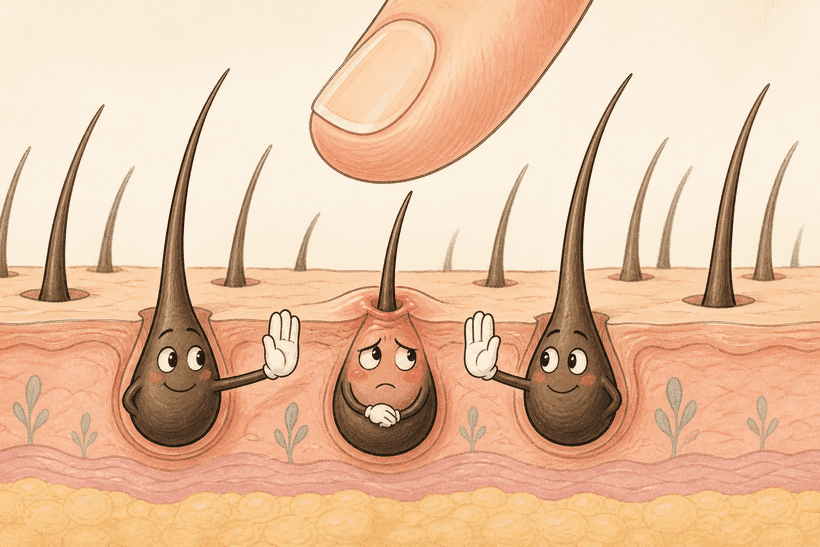
Small red bumps can appear in the recipient or donor area after a hair transplant. A few pustules often settle without lasting trouble, but squeezing or opening them with a needle is best avoided. A bump cannot reliably be identified as simple folliculitis, infection, a cyst, or another inflammatory scalp condition from appearance alone.bunagancomplications
Why do pimples appear after a transplant?
Post-transplant folliculitis causes red bumps or small pus-filled spots around follicles. It can occur where grafts were placed or at the back of the scalp after FUE harvesting. It is often noticed weeks later as hair begins to emerge, although the timing varies widely.bunaganfue-review
Not every case is a bacterial infection. A growing hair can turn inward, or the skin can react to tissue left from the grafting process, producing sterile folliculitis. Increasing pain, spreading redness, or persistent drainage raises a different concern and warrants an assessment for infection.fue-review
Does a pimple mean the graft has failed?
One bump does not by itself mean that a transplanted follicle has died. A study of 27 patients with recipient-area folliculitis found that lesions appeared from two days to six months after surgery and were usually a few to a moderate number of pustules. In that series, they healed without scarring or an effect on graft growth.bunagan
That was a small retrospective study. Its reassuring result should not be extended to rapidly spreading inflammation or a deep abscess.
Why you should not pop it yourself
Fingernails and needles can injure healing skin and introduce bacteria. The risk of unnecessary trauma matters even more while scabs remain or the recipient area is still sensitive.
A practical first response is to:
- leave the bump alone rather than scratch or squeeze it;
- wash only as instructed by the surgical clinic;
- avoid oily hair products and unapproved ointments;
- photograph the area in the same lighting to track the number and spread; and
- send the clinic a clear photo with the date the bump appeared.
Routine antibiotic ointment is not necessary for everyone. An international expert consensus states that topical antibiotics are not usually required simply to prevent folliculitis. Treatment of an actual lesion depends on its location, cause, and severity, so do not apply leftover antibiotics or acne medication on your own.consensus
When to contact the clinic promptly
The surgical clinic can give the most relevant advice even for one or two small spots. Seek prompt medical advice if:
- redness is spreading quickly;
- pain, warmth, or swelling is getting worse;
- pus or foul-smelling drainage continues;
- many lesions appear together or keep returning;
- fever or flu-like symptoms develop; or
- there is a deep firm lump, skin breakdown, or a new patch of hair loss.
Pustules and crusting that repeatedly return months after surgery, especially with pain or hair loss, should not automatically be treated as an ordinary postoperative pimple. Rare inflammatory scalp disorders have been reported after transplantation and need dermatologic assessment.inflammatory
Bottom line
Small pimples can occur after a hair transplant, and mild cases do not usually mean that the grafts have failed. Popping them or using leftover medication is not a good shortcut. Leave the area alone, take a clear photograph, and ask the surgical clinic. Increasing pain, redness, pus, or systemic symptoms calls for prompt medical care.
Sources
- Bunagan MJK, Pathomvanich D, Laorwong K. Recipient area folliculitis after follicular-unit transplantation: characterization of clinical features and analysis of associated factors. Dermatol Surg. 2010;36(7):1161-1165. doi:10.1111/j.1524-4725.2010.01601.x.↩
- Kerure A, Patwardhan N. Complications in Hair Transplantation. J Cutan Aesthet Surg. 2018;11(4):182-189. doi:10.4103/JCAS.JCAS_125_18.↩
- Complications in follicular unit excision hair transplantation: current evidence and practical approaches. Front Med. 2026. PMCID: PMC12909172.↩
- Vañó-Galván S, et al. An international expert consensus statement focusing on pre and post hair transplantation care. J Dermatolog Treat. 2023;34(1):2232065. doi:10.1080/09546634.2023.2232065.↩
- Amri M, et al. Inflammatory complications after hair transplantation: Report of 10 cases. J Cosmet Dermatol. 2023;22(1):207-211. doi:10.1111/jocd.14979.↩